 Mantanetwork
 Ethereum scaling and zero-knowledge applications
Last updated:Mantanetwork is a blockchain ecosystem that runs Ethereum-compatible applications on Manta Pacific, its Ethereum Layer 2 network, and develops tools for zero-knowledge proofs. Its modular architecture separates application execution from the availability of transaction data. Manta Atlantic, its former Polkadot network, has stopped producing blocks, so older descriptions of Atlantic's privacy and staking services now describe a discontinued chain.
Pacific's infrastructure and an application's privacy features do different jobs. Solidity contracts handle application logic, ETH pays gas, Celestia provides data availability, and MANTA has separate token roles. An application gains confidentiality only for the information that its privacy mechanism actually protects.
Running Solidity applications on Manta Pacific
Manta Pacific executes Solidity smart contracts in an environment that follows Ethereum's virtual machine. The Ethereum Virtual Machine, or EVM, runs the instructions that determine how an application's contracts change balances and state. That shared execution model lets DeFi interfaces and on-chain games use familiar Ethereum development libraries and contract code on the same network, even when their business logic differs. Application contracts determine which operations a user can perform and which assets they recognize.
Existing code needs its surrounding dependencies as well. A contract that calls another contract needs that dependency on Pacific, with the correct address. EVM compatibility doesn't automatically reproduce Ethereum's deployed application state or liquidity. Hardhat and Foundry support familiar development workflows, while testing against Pacific's environment addresses the differences that matter to a deployment.
Execution, Celestia data, and Ethereum settlement
Pacific's modular design assigns execution, transaction-data availability, and settlement to components with different responsibilities. Its OP Stack-based execution environment processes smart-contract instructions. Celestia supplies data availability, meaning that participants can obtain the transaction data needed to reconstruct activity, while Ethereum receives commitments to Pacific's state. Separating these functions lets the network scale application execution without asking one component to perform every blockchain task.
A sequencer orders incoming transactions into blocks. Inclusion gives a transaction an execution result, while settlement concerns the chain's commitments on Ethereum; fast finality concerns confidence in those commitments and differs from a bridge delivering assets. Pacific's fast-finality design combines MANTA delegation through Symbiotic with Bitcoin-based validation through Babylon. A withdrawal route can impose additional release conditions even after an application reports successful execution. Celestia's availability and Ethereum's settlement process therefore remain relevant dependencies beyond the application itself.
Mainnet balances and Ethereum bridging
Manta Pacific maintains its own balances and contracts, even when a wallet uses an Ethereum-style address. Its mainnet chain ID is 169. Manta Pacific uses ETH as its gas currency. Gas pays for the computation that a transaction consumes. ETH held on Ethereum mainnet and ETH available on Pacific belong to separate chain states, so a wallet's Ethereum balance doesn't automatically fund Pacific transactions.
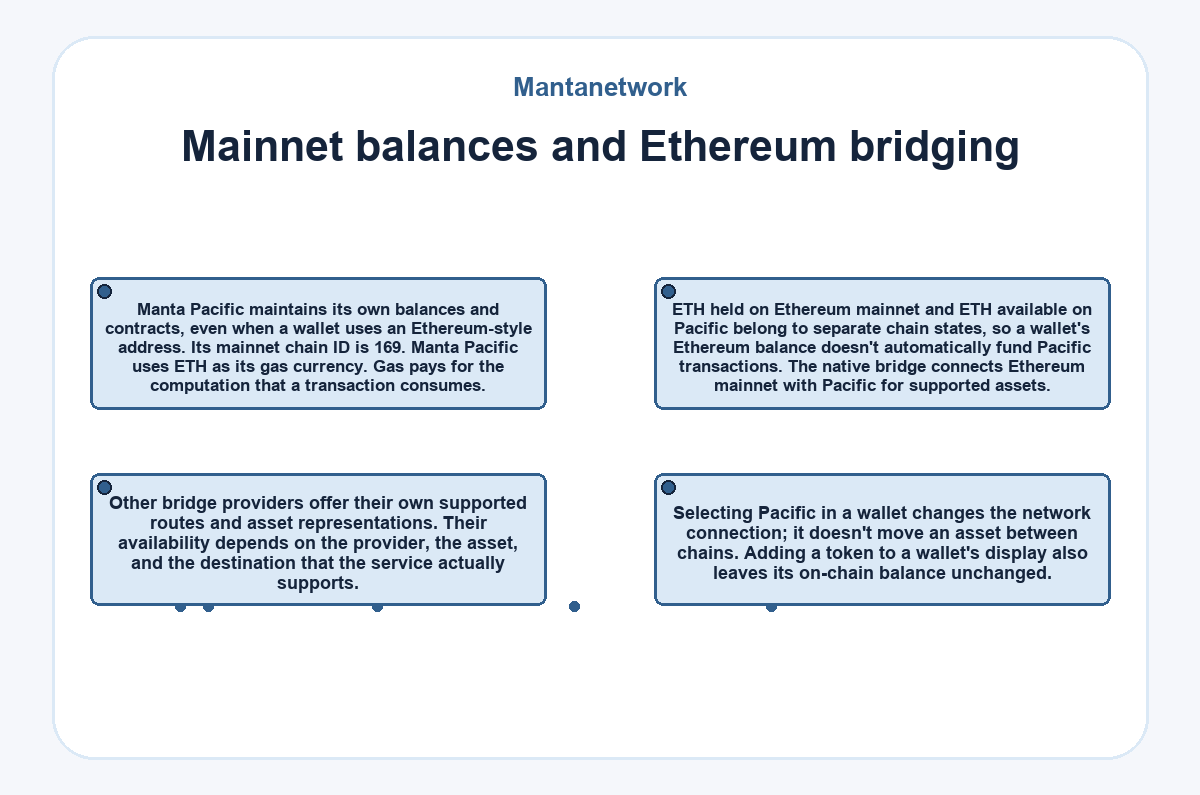
The native bridge connects Ethereum mainnet with Pacific for supported assets. Other bridge providers offer their own supported routes and asset representations. Their availability depends on the provider, the asset, and the destination that the service actually supports. Selecting Pacific in a wallet changes the network connection; it doesn't move an asset between chains.
Adding a token to a wallet's display also leaves its on-chain balance unchanged.
Execution fees and the data-cost component
Pacific transaction costs include execution and data-related components, which change with transaction contents and network conditions. Execution gas measures the work that the contract performs, while the additional component covers the transaction's data-related cost within the rollup's fee model. Fee estimation needs the complete transaction and the network's applicable parameters, because a gas-unit estimate alone doesn't describe every cost that the transaction can incur. Celestia's role can reduce data costs, but it doesn't establish one permanent fee for every contract call. Native bridging also involves gas on the relevant chains. The native bridge doesn't add a separate bridge-specific service fee, while another provider can apply its own charges. Application fees, such as a pool's trading charge, belong to another layer of the total cost.
Does Manta Pacific make every transaction private?
Ordinary Pacific transactions remain visible unless an application implements a specific mechanism that protects their information. A zero-knowledge proof lets a prover establish a statement without revealing the secret information used to prove it; that secret information is the witness. A verifier checks the proof against the statement and its public inputs. Public inputs stay public; the proof's confidentiality applies to the witness, within the guarantees of the chosen proof system.
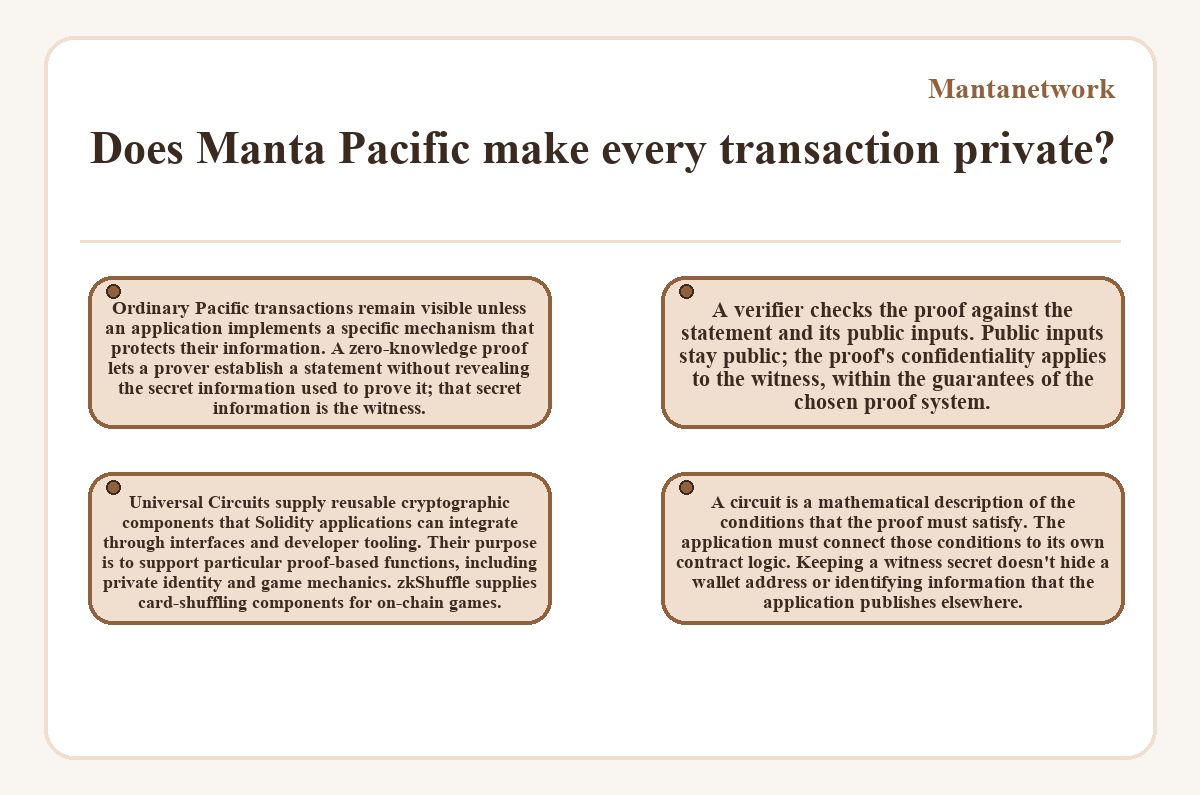
Universal Circuits supply reusable cryptographic components that Solidity applications can integrate through interfaces and developer tooling. Their purpose is to support particular proof-based functions, including private identity and game mechanics. zkShuffle supplies card-shuffling components for on-chain games. A circuit is a mathematical description of the conditions that the proof must satisfy. The application must connect those conditions to its own contract logic. Keeping a witness secret doesn't hide a wallet address or identifying information that the application publishes elsewhere.
Where MANTA fits beside ETH
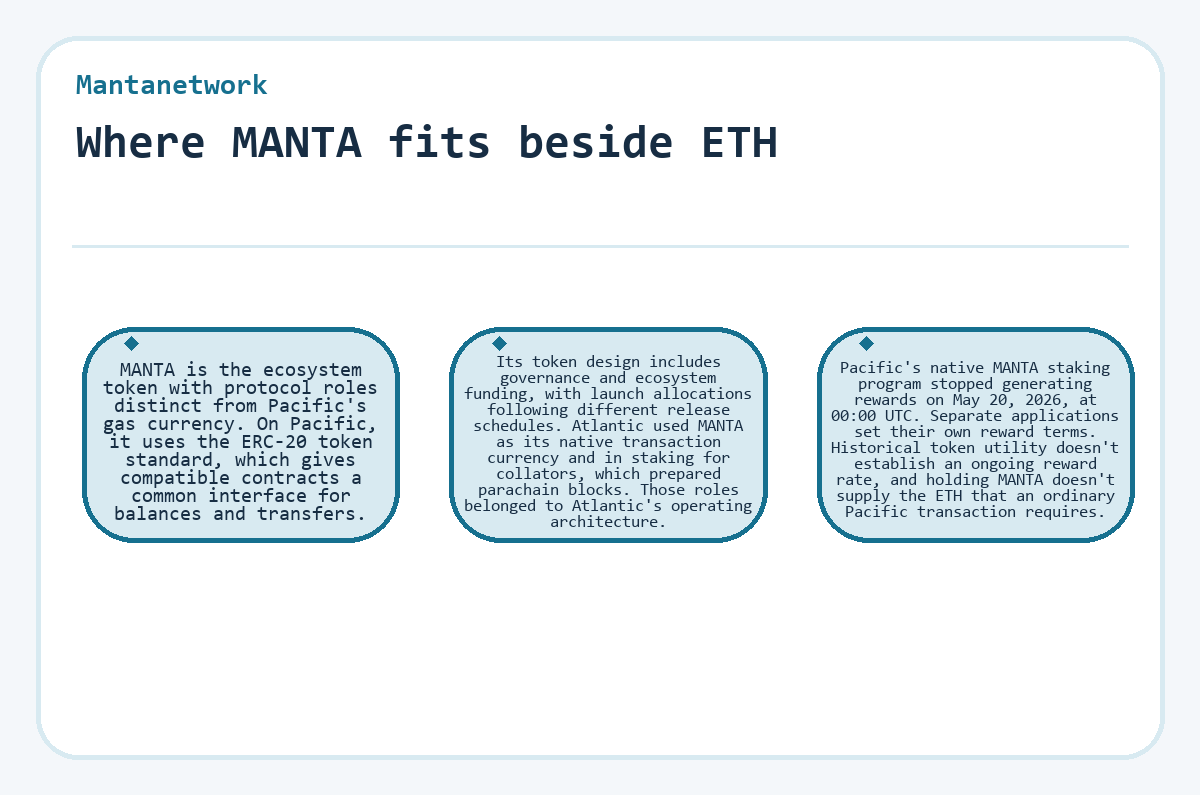
MANTA is the ecosystem token with protocol roles distinct from Pacific's gas currency. On Pacific, it uses the ERC-20 token standard, which gives compatible contracts a common interface for balances and transfers. Its token design includes governance and ecosystem funding, with launch allocations following different release schedules. Atlantic used MANTA as its native transaction currency and in staking for collators, which prepared parachain blocks. Those roles belonged to Atlantic's operating architecture. Pacific's native MANTA staking program stopped generating rewards on May 20, 2026, at 00:00 UTC. Separate applications set their own reward terms. Historical token utility doesn't establish an ongoing reward rate, and holding MANTA doesn't supply the ETH that an ordinary Pacific transaction requires.
Manta Atlantic's shutdown and the claim transition
Manta Atlantic was a Polkadot parachain focused on zero-knowledge identity and privacy-related applications. Its credential work included zero-knowledge soulbound tokens, or zkSBTs. MantaPay was part of the project's work on shielded payments for multiple assets. These functions explain the ecosystem's earlier privacy emphasis; they shouldn't be read as features that every Pacific application automatically inherits.
The 2026 deprecation shifted blockchain development toward Pacific after the project decided not to renew Atlantic's parachain slot. Manta Atlantic has stopped producing blocks. Ordinary on-chain transactions there are no longer possible. The MANTA claim process now uses an off-chain ownership signature and a Pacific receiving account, with availability limited by its claim window.
A signature proves control of the Atlantic account. It doesn't by itself establish receipt of tokens on Pacific. The distributor must hold enough MANTA to cover a recognized claim. Only MANTA falls within this claim program.
Scaling and hidden game information in one application
In this hypothetical example, an application needs familiar smart-contract execution and a way to verify hidden game information; the question is whether the scaling layer supplies both functions automatically. The ecosystem's EVM execution layer runs the contract, while a prover uses a suitable zero-knowledge circuit to generate a proof about the protected information.
The shuffling circuit lets the contract check a proof of valid card shuffling. The contract can accept that proof without receiving the secret information that the proof protects, and ordinary contract execution still handles the public state updates.
The confidentiality holds only if the application uses a suitable circuit and keeps the protected inputs out of public transaction data.
DeFi integrations, social credentials, and on-chain games
Pacific supports applications whose requirements extend beyond inexpensive execution, including exchanges, social credentials, and games. DODO's Pacific deployment includes exchange contracts, and its routing uses the liquidity sources available to that deployment. A trade's execution price and pool charges differ from the network's gas bill, so inexpensive gas doesn't establish an inexpensive swap. Liquidity and contract-specific trading conditions still govern the exchange. Applications that combine multiple contracts also need their integrations to exist in the same supported environment.
Social applications can integrate credential proofs, while games can use cryptographic components for hidden information. These uses depend on the particular interface and proof system that the application chooses. Ethereum mainnet remains a different deployment environment when an application depends directly on contracts or liquidity there. Pacific's EVM compatibility helps reuse code, but the destination's deployed dependencies determine whether that application can perform the same functions.
Mantanetwork: the short answers
Can I connect MetaMask to Manta Pacific?
MetaMask supports Manta Pacific's Ethereum-compatible environment. The wallet needs a Pacific network configuration, and mainnet uses chain ID 169 with ETH for gas. Connecting a wallet doesn't transfer its Ethereum assets to Pacific. The same account can appear on both networks while showing different balances, because each network maintains its own state.
How can an Ethereum contract's sender address change on Pacific?
Pacific applies address aliasing to transactions that originate from Ethereum smart contracts. Aliasing transforms the sender address for the cross-chain message to prevent impersonation. Ordinary Pacific user transactions retain their sender addresses. A contract that authenticates an incoming message must account for the sender representation that its specific cross-chain path uses.
Why doesn't deploying a token automatically add it to the native bridge?
Token deployment and bridge listing serve separate functions. A supported Ethereum token needs the appropriate Pacific counterpart and bridge configuration. The native bridge's token list identifies the Pacific token and its Ethereum origin. Creating an arbitrary ERC-20 contract or importing its address into a wallet doesn't establish that relationship or make the bridge interface list it.
Are rebasing tokens compatible with the canonical bridge?
The canonical bridge excludes rebasing and fee-on-transfer tokens because their behavior can cause bridge accounting errors. Rebasing changes balances through the token's supply mechanism, while fee-on-transfer behavior can reduce the amount that a recipient receives. This restriction concerns that bridge's accounting model; another provider's compatibility follows its own implementation and supported asset list.
When does the Atlantic MANTA claim window close?
The claim window closes on November 16, 2026, at 08:00 UTC. It opened on September 17, 2026, at 08:00 UTC. The portal uses an off-chain signature to establish control of an Atlantic account and designates a Pacific account to receive MANTA. The window governs this claim program, rather than ordinary Pacific bridging.
Does Pacific's native staking program still generate rewards?
The native Manta Pacific staking program stopped generating rewards on May 20, 2026, at 00:00 UTC. That cutoff concerns the named program and doesn't define reward terms for every staking application in the ecosystem. A separate application's rewards, withdrawal rules, and operator arrangements follow its own contracts and program terms.
Is MANTA's launch supply the same as its circulating supply?
MANTA's genesis supply was 1,000,000,000 tokens, while circulating supply measures tokens in circulation at a particular time. Launch allocations and their release schedules affect how much supply becomes available. The token design also included emissions, so the genesis figure shouldn't be treated as a permanently fixed total supply. When comparing bridge representations, don't count the same underlying tokens twice.